








Amino acid mixes get the building blocks your muscles need to heal themselves faster than protein powder, which takes 1 to 2 hours to absorb. Depending on how you train, you’ll need different formulations: BCA with a lot of leucine. For strength athletes, full EAAs for endurance, and full profiles for bodybuilding.
Time them wisely. Take BCAAs before your workout and EAAs after your training. For best results, pair them with quick carbohydrates. Learn these steps to unlock your recovery potential.
What Are Amino Acid Blends and How Do They Work?
Recovery is the most important part of getting better at sports, and amino acid mixes are the basic building blocks your muscles need to heal and get stronger after hard exercise. These particular supplements have combinations of vital amino acids that your body can’t make on its own. It makes them very important for repairing muscles and generating new proteins.
When you work out hard, you make tiny tears in the fibers of your muscles. Amino acid blends speed up the healing process by giving your body nutrients that start the process of making new muscle tissue, which is called muscle protein synthesis. Branched-chain amino acids (BCAAs) are especially important since they are broken down directly in muscle tissue instead of the liver.
This focused approach to optimizing recovery makes sure that your muscles get the nutrients they need right away when they need them the most.
Essential Amino Acids vs. BCAAs
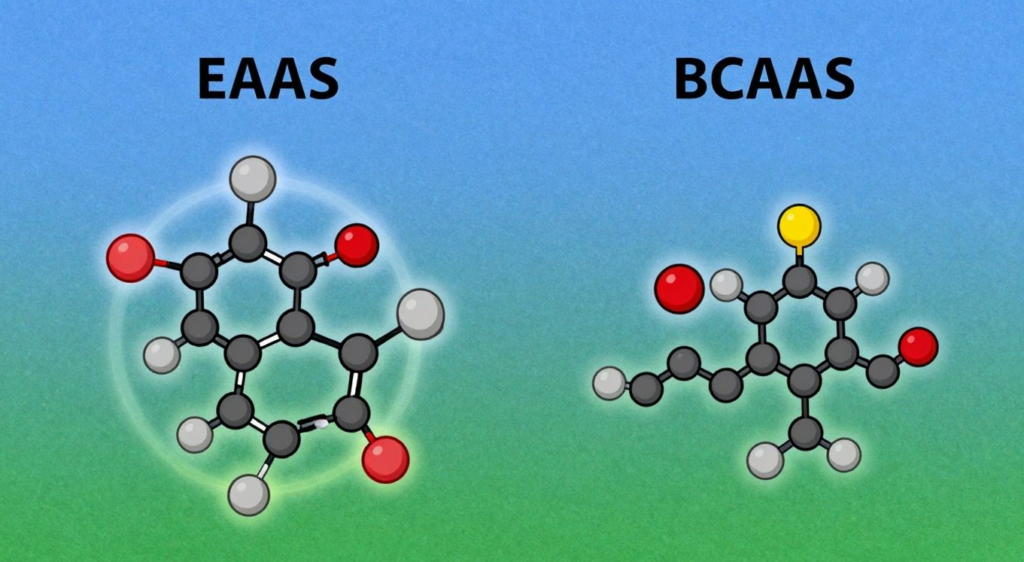
For years, branched-chain amino acids (BCAAs) have been the most popular type of supplement. Still, now essential amino acids (EAAs) mixes are showing to be better for long-term muscle recovery.
EAAs give you all nine essential amino acids, not just the three BCAAs that are in most supplements. This whole profile causes a higher anabolic response and helps with full protein synthesis.
Studies suggest that EAAs are better than BCAAs for recovering after a workout because they give your muscles all the building blocks they require. BCAAs can help you workout, but they’re not enough for the best repair.
EAAs contain leucine, isoleucine, and valine, as well as histidine, lysine, methionine, phenylalanine, threonine, and tryptophan, which will help your muscles feel better and heal faster. Choose EAAs to help your muscles fully recover.
Why Amino Acid Supplements Beat Protein Powder for Recovery
Amino acid supplements are much better at rebuilding muscle tissue than protein powder when it comes to how quickly they are absorbed. You’re getting building blocks that have already been broken down and will get into your bloodstream in 15 to 30 minutes. Protein powder, on the other hand, takes 1 to 2 hours to digest and release amino acids fully.
This timing advantage is highly important for recovery nutrition in the time after your workout. Amino acids like EAAs and BCAAs quickly stimulate muscle protein synthesis without requiring the digestion of whole proteins. Your post-training supplements become more targeted and useful.
Amino acid blends also help keep a better nitrogen balance during times of heavy workouts. Protein powder gives you mixed ratios, but with this product, you can customize the exact amino acid profiles that meet your recovery needs, which speeds up repair and reduces digestive stress.
Best Amino Acid Blends for Strength, Endurance, and Bodybuilding
Strength athletes, endurance athletes, and bodybuilders all have different physiological needs. They will all benefit from amino acid formulas that are made to accommodate their individual training stress and recovery patterns.
Strength athletes should focus on branched-chain amino acids (BCAAs) with high levels of leucine to get the most out of their muscle protein turnover during heavy lifting sessions. Before and after training, you should take 10 to 15 grams.
For strength-focused athletes who lift high weights, taking 10–15g of leucine-rich BCAAs before and after training is the best way to boost protein synthesis.
Endurance athletes need essential amino acids (EAAs) to keep their muscles from breaking down during long workouts. A 2:1:1 BCAA ratio with more glutamine helps keep lean muscle when doing long aerobic sessions.
Bodybuilders need complete EAA profiles that include all nine essential amino acids to get the most out of their recovery time between high-volume training days. You should take 15 to 20 grams of full EAAs after your workout to have the most anabolic response for muscle growth and repair.
When to Take Amino Acids and How to Use Them Together
You’ll need to plan your supplements around your exercise times and daily protein consumption because timing affects how well your body uses amino acids to repair muscles.
Taking BCAAs 15 to 30 minutes before working out will help keep your muscles from breaking down while you work out. Consume EAAs immediately after your workout, when muscle protein synthesis peaks, to maximize recovery. The right amount for you depends on how much you weigh and how hard you train.
Usually, you should take 10 to 15 grams of BCAAs or 15 to 20 grams of EAAs every session.
After working out, combine amino acids with carbs that digest quickly to improve absorption and glycogen replenishment. If you’re working out for a long time, drink BCAAs during your workout to keep your energy up and your exhaustion down.
To get the most muscle repair advantages from amino acid supplements, take them at least 2–3 hours before or after complete protein meals.
